
Common Porsche Suspension Problems Colorado Drivers Should Not Ignore
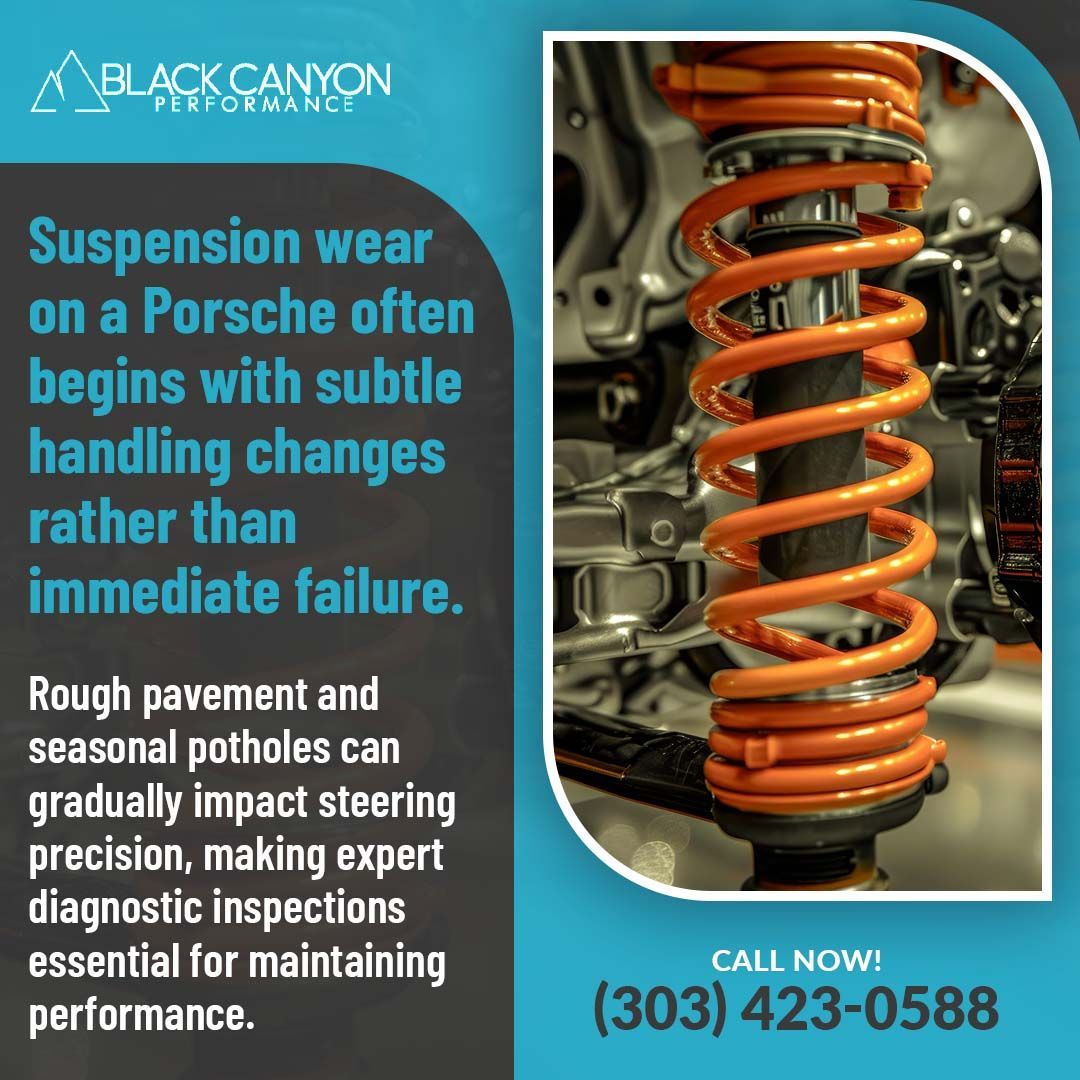
Front Range roads experience wide temperature swings, mountain elevation changes, winter moisture, rough pavement, and seasonal potholes that place added stress on Porsche suspension systems. Conditions throughout Arvada and the surrounding Front Range can accelerate wear on bushings, dampers, steering components, and alignment geometry faster than many drivers expect. At Arvada's elevation of 5,350 feet, temperature swings are sharper, and road deterioration moves faster than factory maintenance schedules often anticipate.
Suspension problems rarely announce themselves loudly. They usually start as subtle clues: a faint knock over a bump, a slight pull in the steering wheel, or a tire wearing unevenly on one edge. Left alone, those small signs become large repairs. Porsche vehicles carry tightly integrated suspension systems where one worn component can cascade into broader handling and safety concerns.
At
Black Canyon Performance European Auto Service, we work on Porsche vehicles regularly and see these issues develop in patterns tied directly to local driving conditions. We outline what accelerates suspension wear on our roads, which warning signs to watch for, and why accurate
Porsche repair and maintenance matter more than a quick visual scan.
Why Porsche Suspension Systems Wear Faster in Colorado
Mountain Roads and Elevation Changes Increase Suspension Stress
Canyon driving generates continuous, repeated lateral loads that highway driving does not. Every curve transfers weight across your suspension geometry. Repeated braking on descents compresses front components hard. Uneven terrain and gravel shoulders keep bushings and dampers working through their full range of motion on every outing.
We see this wear pattern consistently on Porsche vehicles that spend time on mountain roads. Porsche vehicles are built to tight tolerances that reward precise inputs. Those same tolerances mean components that handle sloppy conditions in a standard SUV will wear noticeably faster in a finely tuned Porsche on this terrain.
Winter Conditions Accelerate Wear
Freeze-thaw cycles damage road surfaces across the Denver metro and foothills. Water seeps into asphalt cracks, freezes, expands, and creates the potholes that appear overnight in late winter. Hitting one at speed transfers a sharp shock directly into control arms, bushings, and struts.
Road salt and moisture also accelerate corrosion on metal suspension components. Sway bar links and strut mounts exposed to repeated salt contact degrade faster than standard inspection intervals assume. We recommend a post-winter alignment check as routine practice, even when you have not noticed obvious handling changes.
Common Warning Signs Your Porsche Suspension Needs Attention
Knowing what to listen to and look for helps you act before a minor issue becomes a costly repair. Here are the warning signs we most commonly see in vehicles brought in for Porsche service.
Clunking or Knocking Sounds Over Bumps
A metallic knock when passing over a bump usually points to worn control arm bushings, sway bar end links, or a failing strut mount. These sounds tend to be clearest at low speeds where suspension travel is greater. The worn component is moving more than it should, placing added load on adjacent parts.
Uneven Tire Wear or Steering Pull
When suspension geometry shifts due to worn components, tires no longer sit at the angle they were designed to run. Accelerated wear on the inner or outer tread edge is a reliable indicator that alignment has drifted. A persistent pull to one side on a flat road usually means a worn bushing or damaged control arm has changed how the wheel sits.
Excessive Bouncing or Poor Ride Control
If your Porsche continues bouncing after hitting a bump instead of settling immediately, the shock absorbers or PASM dampers are likely worn. PASM (Porsche Active Suspension Management) performance degrades gradually. Drivers often adapt and do not notice how much handling confidence has been lost until we run a proper diagnostic comparison.
Vehicle Sitting Lower on One Side
On Cayenne and Panamera models with air suspension, a vehicle sitting lower on one corner signals an air strut leak, a failing compressor, or a valve block issue. Continuing to drive on a compromised air suspension overworks the compressor and turns a moderate repair into a far costlier one.
The Most Common Porsche Suspension Problems We See in the Denver Area
These are the suspension issues that come through our shop most often. Each one is manageable when caught early. All require accurate Porsche service and repair, not a generic parts swap.
Worn Control Arms and Bushings
Control arm bushings absorb vibration and maintain wheel alignment through suspension travel. On Cayenne and Macan models used as daily drivers on local roads, these bushings face heavy, varied loads. When they wear, the result is increased vibration through the steering wheel, alignment instability, and a vague feel during cornering. Replacement is straightforward when addressed early, but delaying it allows misalignment to wear tires unevenly and stress adjacent steering components.
Porsche PASM Damper Failures
PASM uses electronically controlled dampers that adjust in real time based on driving conditions. When they begin to fail, symptoms include increased body roll, a rougher ride, and inconsistent damping from corner to corner.
PASM problems can resemble tire, alignment, or steering concerns, which makes proper testing important before replacing parts. Replacing parts without that step often results in unnecessary expense.
Air Suspension Leaks on Cayenne Models
Air struts and supply lines are wear items. Leaks develop at air spring seals, strut fittings, or supply lines. As pressure drops on an affected corner, the compressor cycles more often to compensate, which leads to premature compressor failure.
Early signs include a slow-settling ride height after parking, increased compressor noise, and a dashboard suspension height warning. When that warning light appears, it is best to schedule an inspection before additional strain damages the compressor. Catching a leak early often prevents more extensive air suspension repairs.
Alignment and Tire Wear Problems
Porsche suspension geometry is set to tighter specs than most vehicles. Even modest deviations from spec, caused by a pothole impact or a worn bushing, show up as uneven tire wear before drivers notice any change in handling feel. Our in-ground alignment rack allows us to measure and correct alignment to factory tolerances, not general guidelines.
Failed Sway Bar Links and Stabilizer Components
A worn sway bar link produces a rhythmic knocking or rattling sound during cornering or lane changes. On mountain roads where lateral forces are higher, this wear accelerates. Failed sway bar components reduce resistance to body roll, which noticeably reduces confidence on canyon roads. Replacement is usually more manageable when identified early.
How Colorado Road Conditions Affect Suspension: Key Data
The effects of rough roads and mountain driving are measurable, not theoretical. Suspension wear is not only tied to driving habits. Road quality and environmental conditions also play a measurable role.
| Factor | Impact on Suspension | Supportable statement |
|---|---|---|
| Potholes and rough pavement | Increased impact loads on shocks, struts, control arms, bushings, and alignment | AAA reports that pothole damage cost U.S. drivers $26.5 billion in vehicle repairs in 2021, showing that rough roads can have measurable repair costs. |
| Poor road surface conditions | Faster wear of suspension and alignment components | TRIP reports that nearly half of Colorado’s major roads and bridges are in poor or mediocre condition, which supports the claim that poor pavement can contribute to greater vehicle wear. |
| Repeated rough-road loading | Gradual suspension fatigue over time | Transportation research on road roughness shows that suspension fatigue increases as road surface roughness worsens, supporting the link between rough roads and component wear. |
Why Accurate Suspension Diagnostics Matter for Porsche Vehicles
Porsche Suspension Systems Are Highly Integrated
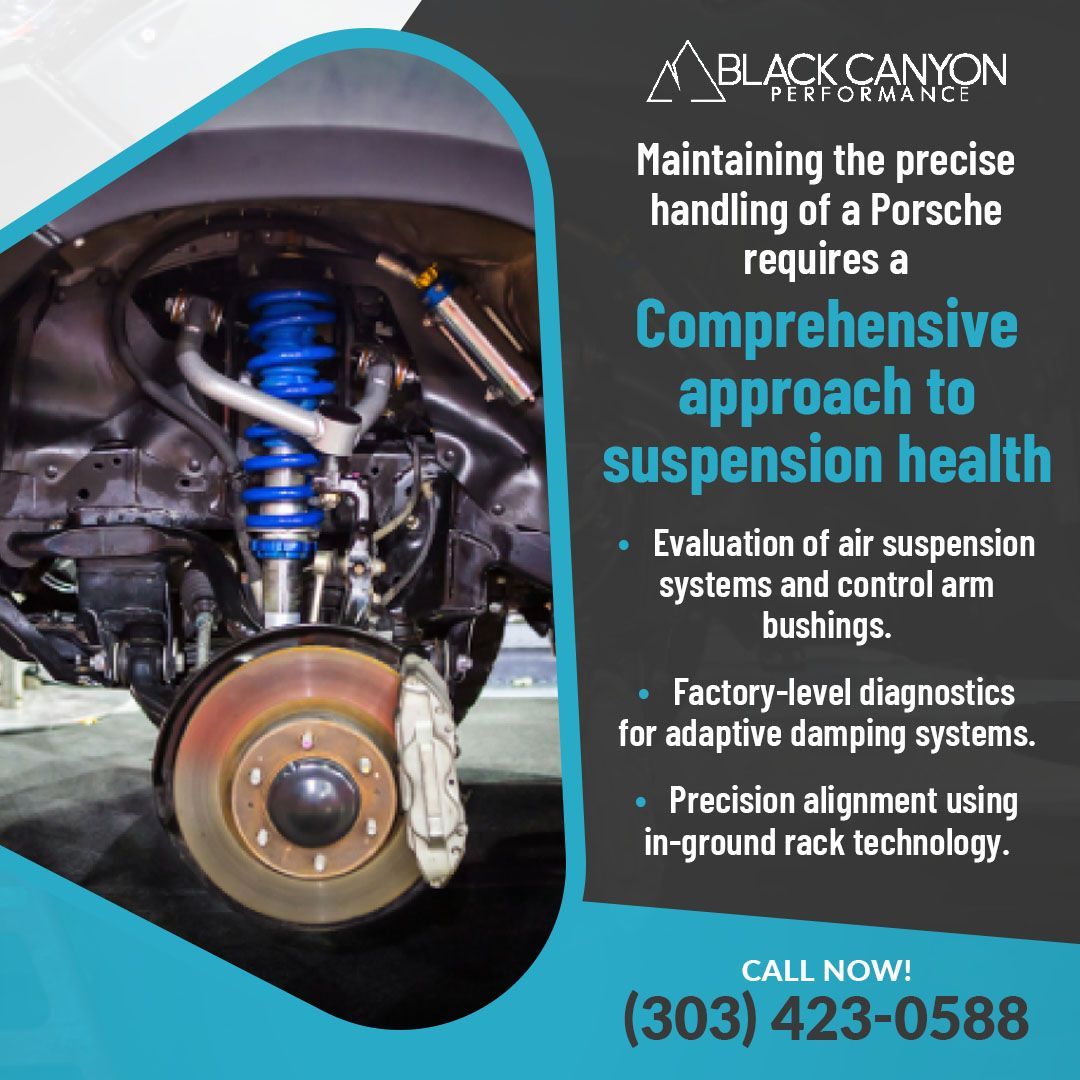
Modern Porsche platforms do not have isolated, independent suspension components. PASM dampers communicate with the vehicle's central control network. Air suspension compressors receive signals from ride-height sensors at each corner. Alignment geometry affects how the adaptive suspension interprets road inputs. When one component fails, the system can mask symptoms or generate fault codes that point away from the actual problem.
This is why we approach Porsche repair and maintenance differently from general vehicle service. Accurate diagnostics require both factory-grade tools and ASE-certified, factory-trained technicians who can interpret what the data actually means, not just which code is displayed.
Generic Inspections Often Miss the Root Cause
A standard scan tool at a general shop may flag a suspension-related code, but cannot access the deeper diagnostic channels Porsche systems use. A technician without platform experience may replace the component the code points to, only for the problem to return because the root cause was elsewhere.
At Black Canyon Performance European Auto Service, our ASE-certified technicians use Porsche-specific diagnostic equipment and follow factory procedures. Every suspension assessment includes a Digital Vehicle Inspection (DVI) with photos and documented findings, so you see exactly what was found and why we recommend what we recommend.
What Happens When Porsche Suspension Repairs Are Delayed
| Initial Problem | What It Can Lead To If Ignored |
|---|---|
| Worn control arm bushing | Alignment drift, premature tire wear, stress on steering components |
| Air suspension leak (Cayenne) | Compressor overload, complete suspension collapse, costly replacement |
| PASM damper wear | Reduced braking stability, increased body roll, uneven tire loading |
| Sway bar link failure | Cornering instability, handling changes on mountain roads |
How Preventive Porsche Service Protects Suspension Components
Routine Suspension Inspections Catch Early Wear
The best long-term suspension strategy is identifying wear before it becomes failure. Routine Porsche service should include a suspension check at every visit. Our inspections cover bushing and control arm condition, damper performance, sway bar link integrity, and ride height consistency across all four corners. Catching a worn bushing before it affects alignment costs far less than replacing the bushing and two tires that wore unevenly because of it.
According to NHTSA, properly maintained tires are essential for safe braking, handling, and overall control, and uneven wear can signal alignment or inflation problems that should be corrected early.
Proper Tire and Alignment Maintenance Matters
Porsche vehicles are aligned to tighter specifications than general passenger vehicles. We recommend checking alignment after any significant pothole impact, at each tire rotation, and at every spring service. Elevation changes and temperature swings in this region cause tire pressure to fluctuate more noticeably than at lower altitudes, and even modest underinflation accelerates shoulder wear on a vehicle with aggressive suspension geometry. This is a routine part of thorough Porsche repair and maintenance that many drivers overlook.
Digital Vehicle Inspections Provide Full Transparency
Every service visit includes a Digital Vehicle Inspection (DVI). You receive photos and technician notes organized by priority level. You see exactly what was inspected, what was found, and what the recommendation is. That level of transparency is standard at our shop, not an add-on.
When To Visit a Porsche Vehicle Specialist in Arvada, CO
Some signs are clear. Others are easy to dismiss. The following situations warrant a suspension inspection from a Porsche vehicle specialist rather than a general repair shop:
- You hear knocking, clunking, or rattling over bumps or during turns
- Your steering wheel drifts or pulls consistently to one side
- Tires are showing uneven wear across the tread width
- Your vehicle bounces more than once after hitting a bump
- One corner sits noticeably lower than the others
- Your dashboard shows a suspension warning or ride height message
- You hit a pothole or significant road damage at speed
A
Porsche vehicle specialist uses platform-specific tools and diagnostic procedures designed for Porsche systems. We serve Arvada, Wheat Ridge, Golden, Lakewood, Westminster, and surrounding Front Range communities. Our staff is salary-based and focused on quality rather than volume, and every job is completed using Porsche-specific diagnostic tools and an in-ground alignment rack.
The Bottom Line
Porsche suspension problems rarely announce themselves loudly. They build gradually from small sounds and subtle handling shifts that are easy to adapt to. Local roads, elevation, and seasonal conditions accelerate that process in ways unique to this region.
Addressing suspension issues early preserves the handling your Porsche was built to deliver. It protects your tires, your steering components, and your confidence on the road. Waiting until the problem is obvious almost always makes the repair more expensive.
If your Porsche has developed suspension noise, uneven tire wear, or ride quality changes, a professional inspection can help identify the cause before the issue progresses further. Black Canyon Performance European Auto Service provides Porsche diagnostics, suspension inspections, alignments, and repair services for drivers throughout Arvada and the Front Range. Contact us at (303) 423-0588 or info@blackcanyonperformance.com for Porsche services in Arvada, CO. We are open Monday through Thursday, 8 AM to 5 PM, and Friday, 8 AM to 4 PM.






Your European Vehicle Dealership Alternative
Highly rated European and Import vehicle care serving the Colorado Front Range. We specialize in BMW, Audi, MINI, Land Rover, Porsche, Volkswagen, Mercedes-Benz and other top European car brands.