What Colorado's Summer Heat Actually Does to a Turbocharged Engine
A turbocharger compresses incoming air so the engine can burn more fuel and produce more power. That process generates intense heat. On a cool day, the intercooler manages that heat well. On a 95°F afternoon in Lakewood or Arvada, the intercooler is already working with warm ambient air. Bringing compressed air temperatures down to a safe range becomes harder.
The result is a system running hotter than it was designed for. Hotter compressed air means a higher risk of detonation. The engine's ECU detects that risk and pulls timing or reduces boost. You feel it as a soft, flat response from the throttle. The car isn't broken, but it is telling you something.
According to NOAA's State Climate Summaries, Colorado temperatures have risen approximately 2.5°F since the early 20th century, with summer averages since 2000 reaching the highest levels in the historical record. For turbocharged vehicles, that trend means summer driving conditions have quietly become more demanding over time.
Why Altitude Makes This Worse for Forced-Induction Engines
Arvada sits at 5,350 feet above sea level. At that elevation, the air is thinner. There are fewer oxygen molecules per cubic foot compared to sea level. A turbocharger compensates by spinning faster to compress what's available. Faster spinning means more friction, more heat, and more stress on the bearings and seals.
At altitude, your turbocharger works harder just to deliver normal performance. Add summer heat on top, and the margin for error shrinks. This is a measurable physical reality for your turbocharged vehicle on the Front Range, not a hypothetical concern.
The Most Common Turbo-Related Problems European Car Owners See in Summer
We track what comes through our European auto repair shop. Summer brings a consistent pattern of issues across the European platforms we service. Three show up more than any others.
Oil Coking and Turbo Bearing Damage
Oil coking happens when engine oil bakes onto the internal surfaces of the turbo during a hot shutdown.
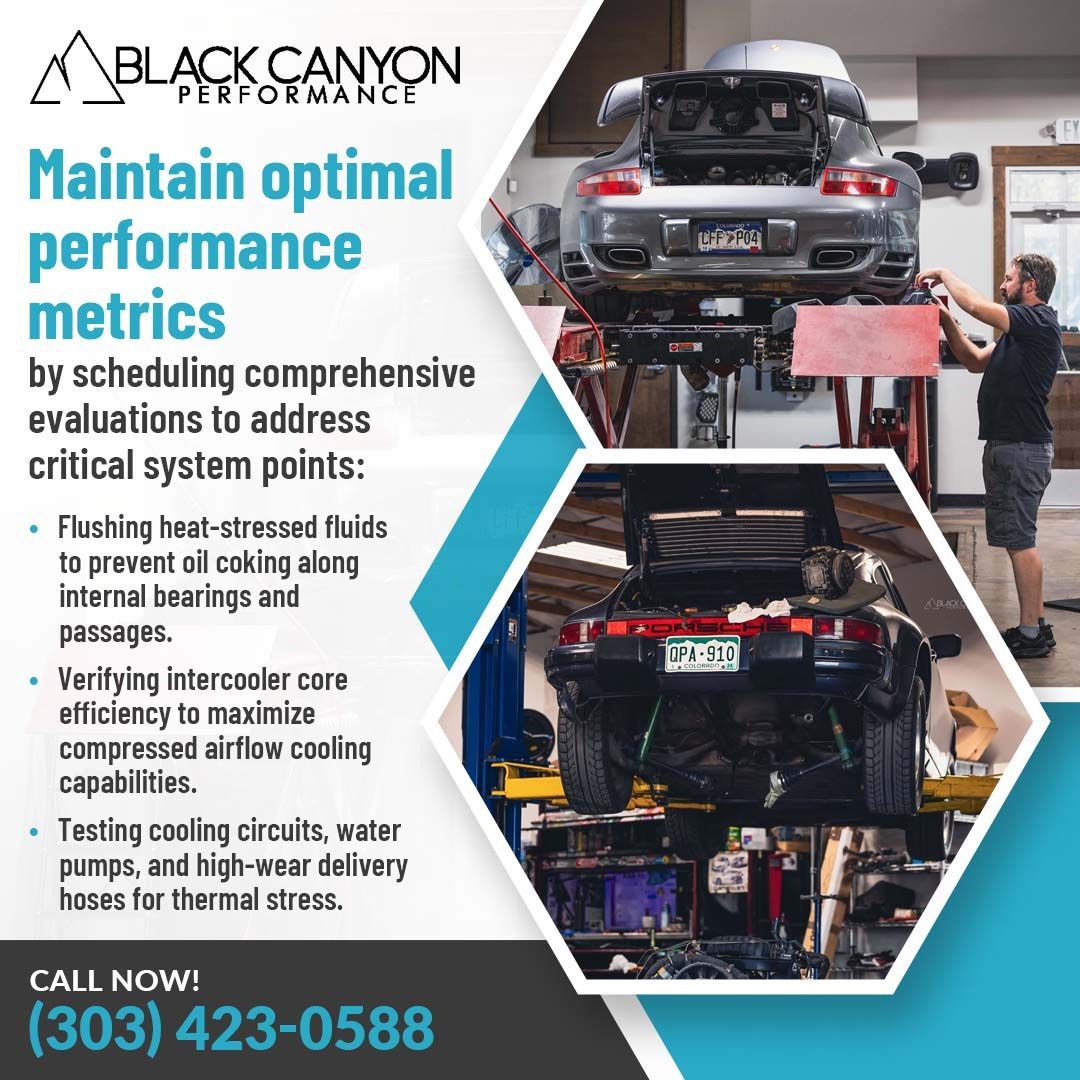
When you turn off a turbocharged engine after hard driving, the turbo keeps spinning momentarily with no oil flow and residual exhaust heat. Oil that pools inside the turbo housing during that window can carbonize. Over time, that carbon buildup restricts oil passages, starves the bearings, and accelerates wear.
Early signs include:
- A faint burning smell after parking
- Slightly elevated oil consumption between changes
- A faint whine at idle that disappears under load
This issue appears across Audi EA888 engines, BMW N55 and B58 platforms, and VW TSI applications. Using the right oil grade and allowing your engine to cool briefly before shutting down after hard driving can prevent it.
Intercooler Efficiency Loss
When ambient temperatures are high, the intercooler cannot drop compressed air temperatures as effectively.
The intercooler works by passing hot compressed air through a core cooled by outside air. At 95°F, that outside air is already warm. The core can only reject heat to air that's cooler than what's flowing through it. When ambient and compressed temperatures converge, the intercooler becomes less effective.
The result is higher intake temperatures. The ECU responds by pulling timing. Power feels flat. Fuel consumption can rise. On platforms like the BMW B58, Audi 2.0T, and VW 2.0 TSI, this shows up as inconsistent throttle response in stop-and-go summer traffic.
Coolant System Stress on Turbocharged Platforms
Turbocharged engines place more demand on the cooling system than naturally aspirated engines of similar displacement.
The turbo itself needs coolant flow to survive a hot shutdown. Many modern turbo designs include a coolant-fed bearing housing that continues circulating fluid after the engine stops. If the water pump, thermostat, or coolant hoses are weakening, summer heat exposes that weakness quickly.
We see more coolant-related visits in June through August than in any other period. We often find these systems were already marginal before summer arrived. Heat just makes the problem impossible to ignore.
Issue
Common Platforms
Early Warning Signs
Oil coking
Audi EA888, BMW N55/B58, VW TSI
Burning oil smell, excessive oil consumption, blue smoke
Intercooler efficiency loss
BMW B58, Audi 2.0T, VW 2.0 TSI
Poor/sluggish throttle response, timing pull, increased intake temps
Coolant system stress
Most turbocharged Euro platforms
Overheating (rising temp gauge), coolant loss, steam
Why Standard Shops Fall Short on Turbocharged European Platforms
Reading a fault code is not the same as diagnosing a turbocharged European vehicle.
A generic OBD-II scanner can tell you a sensor has flagged. It cannot tell you what boost pressure is doing across a driving cycle or whether a turbo actuator's response is within factory tolerance. Answering those questions requires platform-specific tools and live data logging.
The difference matters because turbocharged European platforms integrate the turbo into a larger system of sensors, adaptations, and control logic. An Audi with a boost-related fault is not the same diagnostic task as a VW with the same fault code. The platforms share architecture but behave differently.
This is where quality European auto repair differs from a general inspection. Our technicians focus on diagnostic accuracy rather than volume throughput, and they have the time and tooling to read what your car is actually doing. Our staff at Black Canyon Performance European Auto Service is salaried, not commission-based. That structure keeps the focus on correct diagnosis, not on how many cars move through the bay.
What a Proper European Auto Repair Service Inspection Actually Covers
When you bring your turbocharged European vehicle to Black Canyon Performance European Auto Service for a summer inspection, the process reflects what thorough
European auto repair services actually look like in practice.
We start with what your car's data actually shows, not assumptions.
Every visit begins with a Digital Vehicle Inspection (DVI). Rather than telling you what we found at the end, we document findings with photos and condition notes as we work through the car. You leave with a clear, itemized picture of your vehicle's actual state, not a verbal summary you have to take on faith.
For turbocharged platforms, here is what that process looks like in practice:
- Oil service using the correct synthetic specification. European turbocharged engines require a specific oil grade. We use the manufacturer-specified synthetic at every service, which protects the turbo bearings and keeps oil from breaking down in summer heat and at altitude.
- Cooling system assessment. We inspect water pump condition, thermostat function, and hose integrity. On turbocharged platforms, a cooling system that is marginal in spring becomes a real problem by August.
- Factory-level diagnostics across systems. We go beyond reading fault codes. Our process involves verifying inputs and outputs, reviewing data logs, and tracing how symptoms connect across your vehicle's systems to find the actual cause, not just the surface signal.
- DVI documentation at every visit.
We photograph findings and note condition details as we work through your car. You leave with a clear, itemized picture of what we found and what it means, not a verbal summary.
AAA's independent research found that synthetic oil performs an average of 47% better than conventional oil in industry-standard tests, and is particularly beneficial for turbocharged engines operating in extreme heat and stop-and-go conditions. We use the correct synthetic specification for every European platform we service, following OEM procedures throughout.
Where turbo health intersects with calibration, we also offer ECU and TCU tuning services. For your turbocharged car running at altitude through peak summer heat, that calibration is part of a complete
European auto service and repair, not an optional upgrade.
What to Look for When Choosing a Shop for Summer Turbo Service
When your turbocharged European vehicle needs diagnosis, not every shop has the tools or platform-specific training these vehicles actually require.
When you're looking for a
European vehicle specialist, the practical questions matter. Does the shop use factory-level diagnostic tools, or only aftermarket code readers? Are technicians trained on specific platforms or on general automotive systems? Is service documented in a way you can reference at future visits?
Our technicians at Black Canyon Performance are
ASE-certified, factory-trained, and focused on European platforms. That depth of platform knowledge matters when diagnosing heat-related turbo issues that don't always set a fault code. We often find that higher-mileage European cars arrive with more than one concern, and powertrain and suspension issues tend to surface together. Our in-ground alignment rack means we can address both without sending you elsewhere.
Our repair work is backed by a 3-year/36,000-mile warranty covering everything from suspension overhauls to electrical and drivetrain repairs. If you want confidence in the work done on a vehicle you rely on every day, that kind of documented coverage matters as much as the repair itself.
Frequently Asked Questions
How often should I change the oil in my turbocharged European car?
Follow your manufacturer's recommended interval and use the correct synthetic grade for your engine. Turbo bearings depend on clean, properly viscous oil at all times, and Colorado's summer heat and altitude accelerate oil breakdown when service is overdue. If you are unsure what interval applies to your platform, we can tell you exactly what your vehicle needs.
Can a general repair shop handle a turbocharged European vehicle?
A general shop can manage basic services, but diagnosing turbo-related issues requires factory-level tools and platform-specific training. Generic code readers surface fault codes. They cannot go deeper to uncover the real cause the way factory-level diagnostics can. We work exclusively on European vehicles and combine that tooling with real-world platform knowledge. That combination matters most when the problem is not straightforward.
How do I schedule a diagnostic inspection at your Arvada shop?
Call us at (303) 423-0588 or use our online booking form. When you come in, describe any symptoms you have noticed. Unusual sounds, flat throttle response, or a burning smell after parking all give us a useful starting point.