Performance Upgrades That Improve Handling on Colorado Canyon Roads

Share this article

Driving through winding mountain roads demands more from your vehicle than everyday commuting. Tight corners, elevation changes, and uneven pavement all place continuous stress on your suspension, tires, and braking system. A car that feels stable on city streets can quickly feel unsettled when pushed through canyon roads.


European vehicles are built with performance in mind, but factory settings are designed to handle a wide range of conditions. They are not always tuned for the specific demands of Colorado’s canyon routes. This is where the right
performance upgrades begin to make a noticeable difference.


At
Black Canyon Performance European Auto Service, we work with drivers who want their cars to feel controlled and predictable in real driving conditions. This level of refinement often requires a specialized European auto service that understands how these platforms behave under real driving conditions. We share information about performance upgrades that improve handling on Colorado canyon roads, along with how proper European car maintenance supports those upgrades over time.

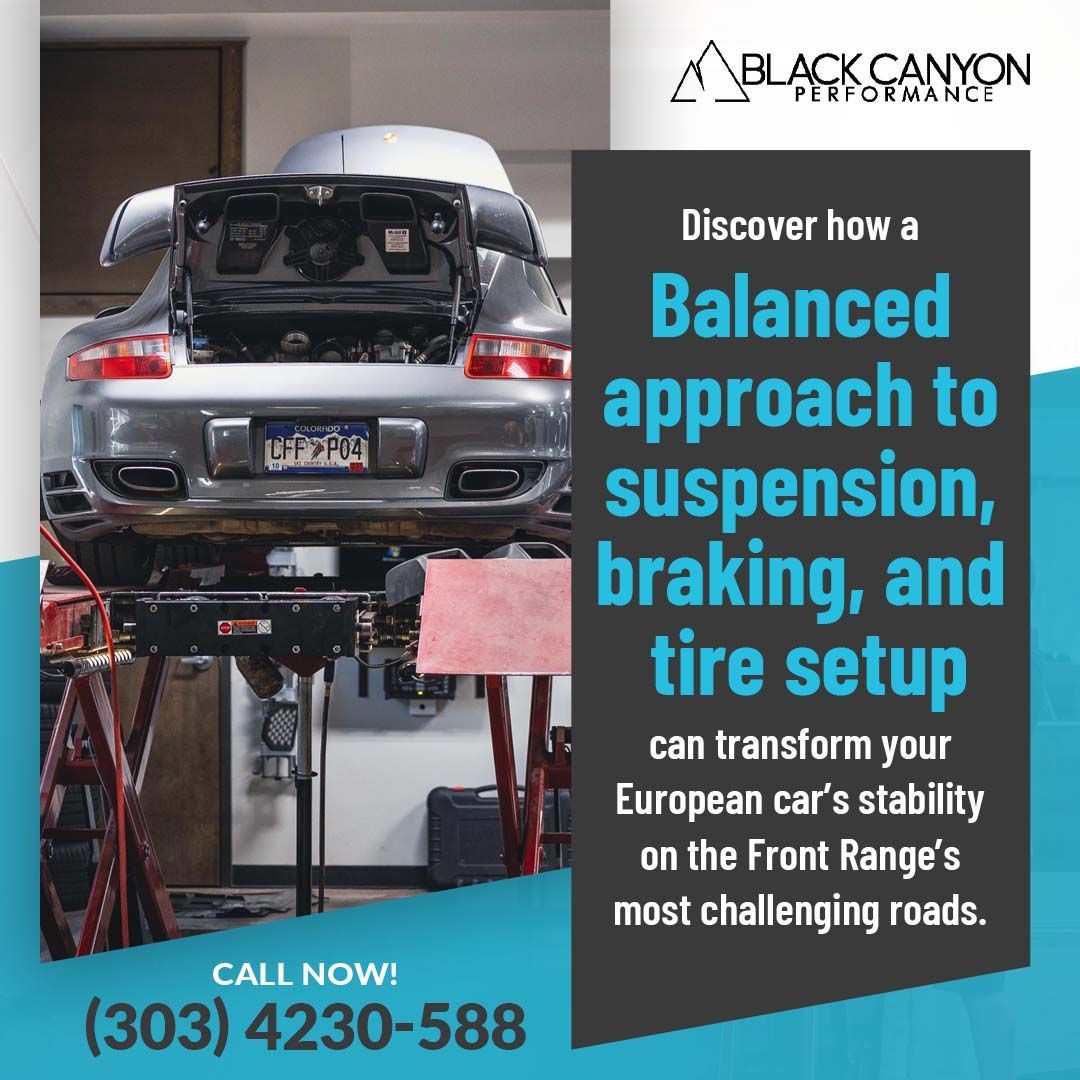
Balanced approach to suspension, braking, and tire setup

Why Colorado Canyon Roads Require More From Your Vehicle

Colorado canyon roads combine demands that factory suspension and brake setups are not optimized to handle repeatedly. Tight, decreasing-radius corners load suspension and tires laterally. Sustained descents build brake heat faster than typical stop-and-go traffic. Pavement quality changes abruptly. Smooth asphalt becomes broken chip seal within the same stretch. Altitude and temperature shifts from canyon base to summit affect grip, brake response, and available engine output.

Driving Factor Effect on Vehicle Systems
Sustained cornering loads Lateral tire forces rise; body roll increases as suspension loads shift outward.
Repeated downhill braking Brake temperatures surge; friction fade and fluid boil risk increase on long grades.
Variable road surfaces Pavement friction fluctuates; suspension travel increases to maintain tire contact.
Elevation and temperature shifts Tire compound stiffness changes; brake torque response varies with ambient conditions.

Suspension Upgrades That Build Cornering Confidence

Performance Shocks, Struts, and Coilovers


Stock dampers are calibrated for ride comfort. On canyon roads, that softness translates to body lean in corners and reduced tire contact over rough patches. We select aftermarket dampers tuned to your specific platform, improving body control without making the car punishing on the daily commute.

​

For drivers who want more adjustability, coilovers replace the factory spring and damper assembly with a unit that lets you set both ride height and spring stiffness. A BMW 3 Series, an Audi S4, and a Porsche Cayman each carry their weight differently. The right setup varies by platform; what works on one does not automatically transfer to the other.


Sway Bars and Suspension Bushings


Upgraded sway bars resist lateral body roll without stiffening the ride the way heavier springs do. Firmer suspension bushings reduce flex in the connection points throughout the suspension system.

​

Together, our suspension upgrades make cornering feel more deliberate and consistent, often more noticeably than dampers alone on a car with high-mileage rubber bushings.


Tire Selection and Fitment for Canyon Grip

Your tires determine the upper limit of what every other handling upgrade can achieve. No suspension modification improves handling beyond what the tire can transmit to the road.

Our tire services include mounting, balancing, seasonal changeovers, and inspection for uneven wear at every visit.


Compound, Sidewall, and Fitment


Summer performance tires use a softer, higher-grip compound than all-season alternatives. On canyon roads in warmer months, the difference in lateral grip is felt immediately through the steering wheel. These tires must not be used below approximately 45°F or in snow. For Front Range driving from spring through fall, they are the correct choice.

​

A stiffer sidewall reduces deflection in hard corners, improving steering precision and turn-in feel. A wider contact patch distributes lateral forces across more rubber. Both changes require correct wheel offset and updated alignment settings; fitting wider tires without recalibrating alignment accelerates uneven wear and makes handling less predictable.

Tire Type Grip Characteristic Appropriate Use
All-season Moderate, consistent across temps Year-round daily driving
Summer performance Higher lateral grip, heat-stable Spring–fall canyon and spirited driving
Track/semi-slick Maximum dry grip Track days; limited street suitability

Brake Upgrades That Hold Up on Descents

Canyon driving builds brake heat faster than most road conditions. Standard setups are not designed to shed that heat efficiently across back-to-back braking zones.


Pads, Rotors, and Fluid


Performance brake pads use friction compounds that stay consistent at higher temperatures. Standard pads lose bite as heat builds. The pedal feels firm, but the stopping distance grows. Upgraded rotors improve heat transfer away from the friction surface, keeping response stable through repeated braking on long descents.

​

Brake fluid is the most overlooked part of this equation. Fluid absorbs moisture over time, which lowers its boiling point. On a long canyon descent, partially vaporized fluid creates a soft, inconsistent pedal exactly when you need firm braking most. We recommend replacing standard fluid with DOT 4 or DOT 5.1. This raises the boiling threshold and is one of the lowest-cost, highest-impact upgrades for canyon driving.

​

For vehicles used in more spirited driving or occasional track sessions, full-performance brake kit upgrades provide added heat capacity. Most daily-driven European cars on Front Range roads do not require this. Upgraded pads, rotors, and fresh fluid typically deliver the improvement needed. Our performance upgrade services include brake system work selected and installed based on how the car is actually used.


Alignment for Precision Handling

Performance Alignment Settings and Our In-Ground Rack


Camber, the inward tilt of the wheel at the top, affects how much tire stays planted during a corner. A small increase in negative camber keeps more of the contact patch working under lateral load. Toe settings control how quickly the car responds to steering input and how stable it feels between corners. With accurate setup at a dedicated European auto service, these adjustments translate into predictable handling on canyon roads.

​

These are small, targeted adjustments. But they require accurate equipment to deliver repeatable results. Our in-ground alignment rack provides the measurement precision that performance settings demand. Any suspension modification; coilovers, sway bar upgrades, or new tires must be followed by a fresh alignment. Skipping that step means the upgrade never fully performs.


Tuning That Supports Handling, Not Just Power

ECU and Transmission Calibration


Power without matching control creates instability. Throttle response that is too aggressive at corner exit overwhelms traction and disrupts balance. Calibrated ECU tuning shapes how power builds through the rev range, making the car more consistent and easier to place accurately through a sequence of corners.

​

Shift timing matters too. A PDK, DSG, or ZF 8-speed that holds a gear too long or shifts too early disrupts balance mid-corner. Adjusted shift points matched to your driving style make the powertrain feel like it is working with your inputs. For BMW drivers, working with an independent BMW service helps ensure tuning adjustments align with factory systems and real-world driving demands.

​

Black Canyon Performance European Auto Service’s factory-trained, ASE-certified technicians handle ECU and TCU calibration in-house through our automotive tuning services, with every project verified through data logging and post-tune testing. Whether you drive a BMW, Audi, Porsche, or another European platform, we draw on a network of respected local and national tuning specialists to calibrate precisely for your car.


Why Maintenance Comes Before Any Modification

Address Wear First


A suspension bushing that has lost its elasticity introduces play into every steering input. A shock absorber that no longer damps properly allows the body to float through corners. Neither condition improves after installing coilovers/ They make the new parts work harder and deliver less.

​

Proper European car maintenance begins with assessing wear across suspension components, brake systems, and fluid condition before any modification. Brake fluid that has absorbed moisture over multiple seasons underperforms under heat, regardless of what pads and rotors are installed. Differential and transmission fluids affect torque transfer under load. Degraded fluid changes how the car puts power down through corners.

​

These are maintenance items, not upgrades. Addressing them first is what protects the value of every modification that follows. Our scheduled maintenance services cover all of these systems with OEM-grade fluids and parts, documented at every visit.


Matching Upgrades to How You Drive

Daily Driver vs. Canyon-Focused Build


For a daily-driven European car, the most practical performance upgrades are:

  • Performance alignment with targeted camber and toe adjustments
  • Summer performance tires for spring through fall
  • Sway bar links and bushing replacement where wear is present
  • Brake fluid flush with DOT 4 or DOT 5.1


These changes are immediately noticeable and do not require significant disassembly or compromise daily comfort.

​

Drivers who want a more committed setup benefit most from coilovers matched to their platform, a fresh alignment calibrated for the new geometry, and tires selected to match the suspension's new capability. This type of build works best as a system, and we recommend completing it as one, because coilovers without a supporting alignment, or tires alone without attention to suspension condition, rarely deliver what the driver expected.

eliminate brake fade and body roll

Choosing the Right Upgrades for Your Driving Style

Should you upgrade for daily driving or canyon runs?


Daily drivers need balance. Canyon-focused cars can prioritize responsiveness.


What is OEM+ vs aggressive setup?


  • OEM+ keeps the factory feel with improved response
  • Aggressive setups increase stiffness and reduce comfort


Do different brands need different upgrades?


Yes. BMW, Audi, and Porsche platforms respond differently.

BMW often benefits from suspension tuning and alignment. Audi may require adjustments for weight distribution. Porsche setups focus on precision.

​

At Black Canyon Performance European Auto Service, performance is not treated as a separate offering. It is built into everything we do. We approach every upgrade with the same care and attention we would give our own vehicles, focusing on improvements that enhance how your car drives on everyday roads, canyon routes, or the track. A Google review by one of our customers, Brian G., says, “Pure professionals who know what is best for your vehicle. They are extremely considerate and friendly, and my car has never looked and driven better. They have no idea how often I’m going to pester them to keep helping me upgrade my new toy.”


Common Mistakes That Reduce Upgrade Value

  • Upgrading suspension without a follow-up alignment: new geometry goes uncalibrated, and the improvement is partial
  • Combining stiff springs with unchanged stock dampers: mismatched rates produce a car that is harsh and poorly controlled
  • Selecting parts without confirming platform compatibility: components that work on one BMW chassis do not automatically suit another
  • Tuning for power before handling is sorted: power through a corner the car cannot manage is a liability, not an asset


Ready to Talk Through Your Vehicle's Setup?

Handling improvements on Colorado canyon roads are achievable with the right combination of performance upgrades and a properly maintained vehicle.

​

At Black Canyon Performance European Auto Service, our factory-trained, ASE-certified technicians start every performance conversation with an honest assessment of what your car currently needs. Our staff is salaried and focused on quality, not volume. We use dealer-grade tools, partner with trusted local and national tuners, and have the in-ground alignment rack to calibrate every build accurately.

Call us at (303) 423-0588 or email us at info@blackcanyonperformance.com to discuss how our European auto service in Arvada, CO, can meet your car needs for Colorado driving.

Vehicles waiting inside the Black Canyon Performance shop beside a two-post lift
By Black Canyon Performance European Auto Service • October 14, 2026
A Porsche repair estimate should itemize parts and labor, state the part type, give a completion date and explain each finding. What Colorado law requires.
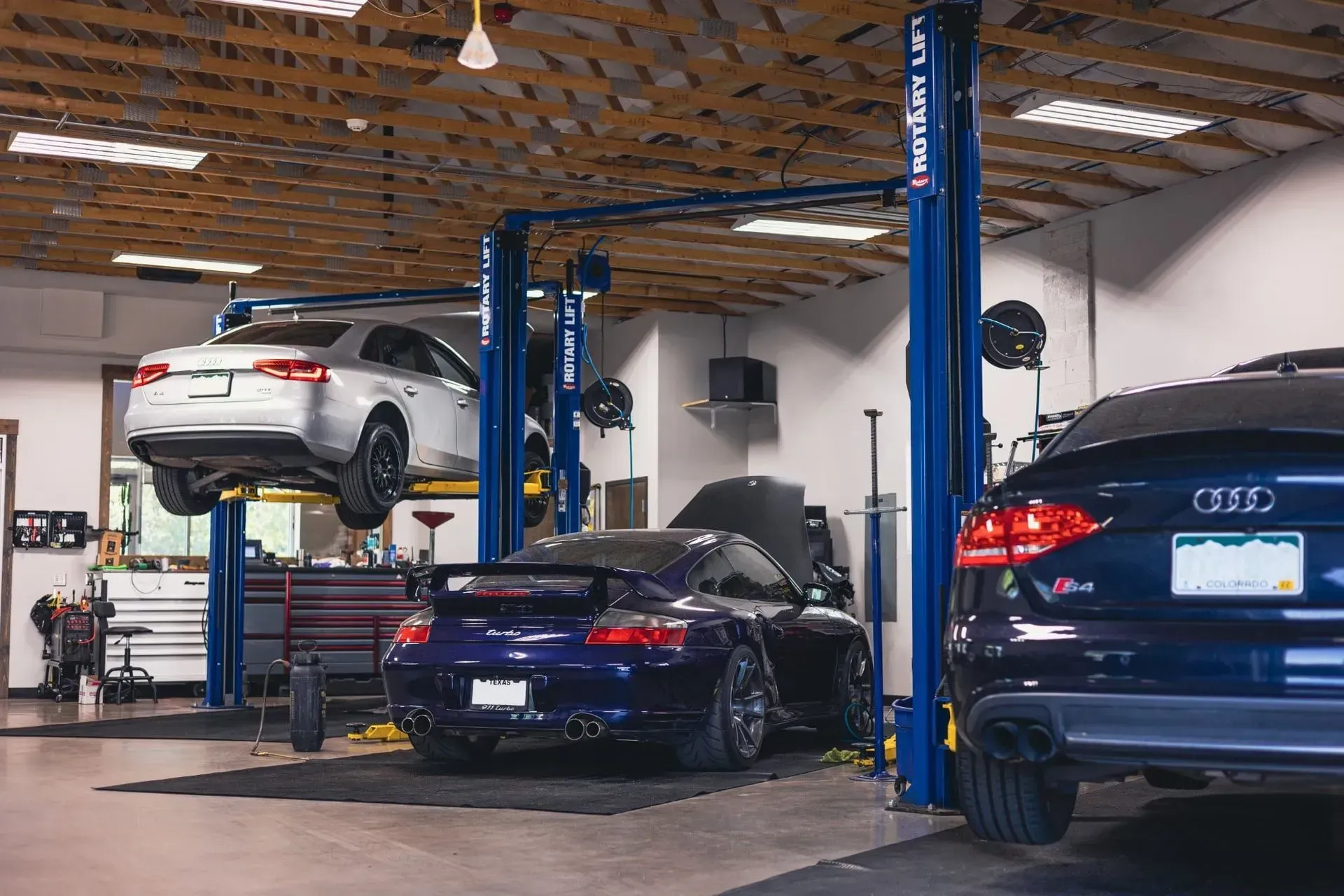
Blue Porsche 911 and an Audi S4 in the Black Canyon Performance service bays beside a car raised on a lift
By Black Canyon Performance European Auto Service • October 14, 2026
Cold PDK fluid thickens and slows hydraulic response, so shifts feel rough until the transaxle warms. When it's normal, and when rough shifting needs a diagnosis.
Technician working on the driver door switch panel of a black car
By Black Canyon Performance European Auto Service • October 14, 2026
A proper European car electrical diagnosis starts with a factory-level scan, live data and a wiring and ground check, all documented before any part is replaced.
Technician running a laptop diagnosis at the driver door with a booster cable clamped under the hood
By Black Canyon Performance European Auto Service • October 14, 2026
A battery that passes a load test can still leave a BMW, Audi, Mercedes or MINI silent. How grounds, parasitic draw and immobilizer faults cause a no-start.
Technician and customer talking beside an open hood with a laptop showing diagnostic data
By Black Canyon Performance European Auto Service • October 14, 2026
A black or frozen PCM screen, repeated restarts, navigation, audio or hands-free failures can signal a Porsche cabin electronics fault. What Porsche has documented.
Technician reviewing a tablet while seated in the doorway of a red car in the shop
By Black Canyon Performance European Auto Service • October 14, 2026
A digital vehicle inspection pairs every finding with photos, notes and a priority, so you see why a repair matters before you approve it. What a DVI includes.
Black Canyon Performance technician in a headlamp lifting an engine component out of an open engine bay
By Black Canyon Performance European Auto Service • October 14, 2026
Dashboard alerts, uneven tire wear, fluid leaks and changes in ride or steering are early signs a European car needs attention. What each one means and what to do.
Dark green Porsche front wheel with a cross-drilled brake rotor and a black Porsche caliper visible through the spokes
By Black Canyon Performance European Auto Service • October 11, 2026
A longer pedal, a pull, a pulse, grinding or the pad wear light can all mean a Porsche needs brakes. What each sign means and when the rotors can stay.
Illustration of two metal coolant pipes joined at a fitting, with a drop of coolant leaking from the joint
By Black Canyon Performance • October 1, 2026
2003 to 2006 Cayenne V8s had plastic coolant pipes; later Cayenne and Panamera models use bonded fittings. What Porsche's records show and what to check.
Show More
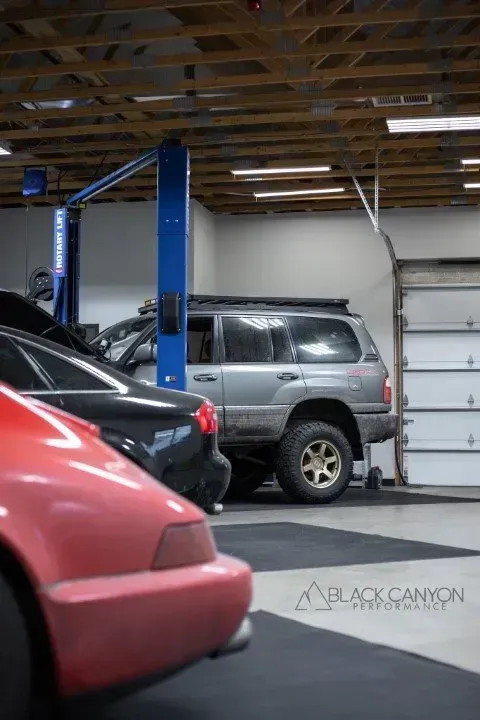
Car lift in auto shop with silver SUV, red car foreground, and garage door in back

Your European Vehicle Dealership Alternative

Highly rated European and Import vehicle care serving the Colorado Front Range. We specialize in BMW, Audi, MINI, Land Rover, Porsche, Volkswagen, Mercedes-Benz and other top European car brands.